

Some years ago, our global head of market access went to a US payer to negotiate formulary placement for one of our molecules. He brought data from a phase 3 program covering thousands of patients, bigger and more comprehensive than anything produced in this the disease area previously. The payer said: “Great, but that’s not what we’re seeing in our patient population.”
The payer’s real-world dataset was larger than the clinical trial. More patients. More current. More reflective of actual outcomes in their specific population. The data advantage had shifted. Our clinical trial data was still valuable, but it was no longer the most powerful data.
The story stuck with me because it confirmed something and I have since argued for it leading the digital health franchise at a major insulin manufacturer. In pharma, the molecule is the moat. Patent protection, clinical development, and getting a molecule to market drive the industry, representing billions of dollars and over a decade of work. I’m not arguing against that, that is still there. But once the molecule is on the market, the competitive advantage shifts to data. The clinical data supporting your label. The real-world evidence that proves outcomes in practice. The usage data that feeds your next-generation products. Those who know the most about the medicine in question is at a competitive advantage, and does is not necessarily the pharmaceutical company. The more value is reflected in usage of a product, the more valuable the data becomes.
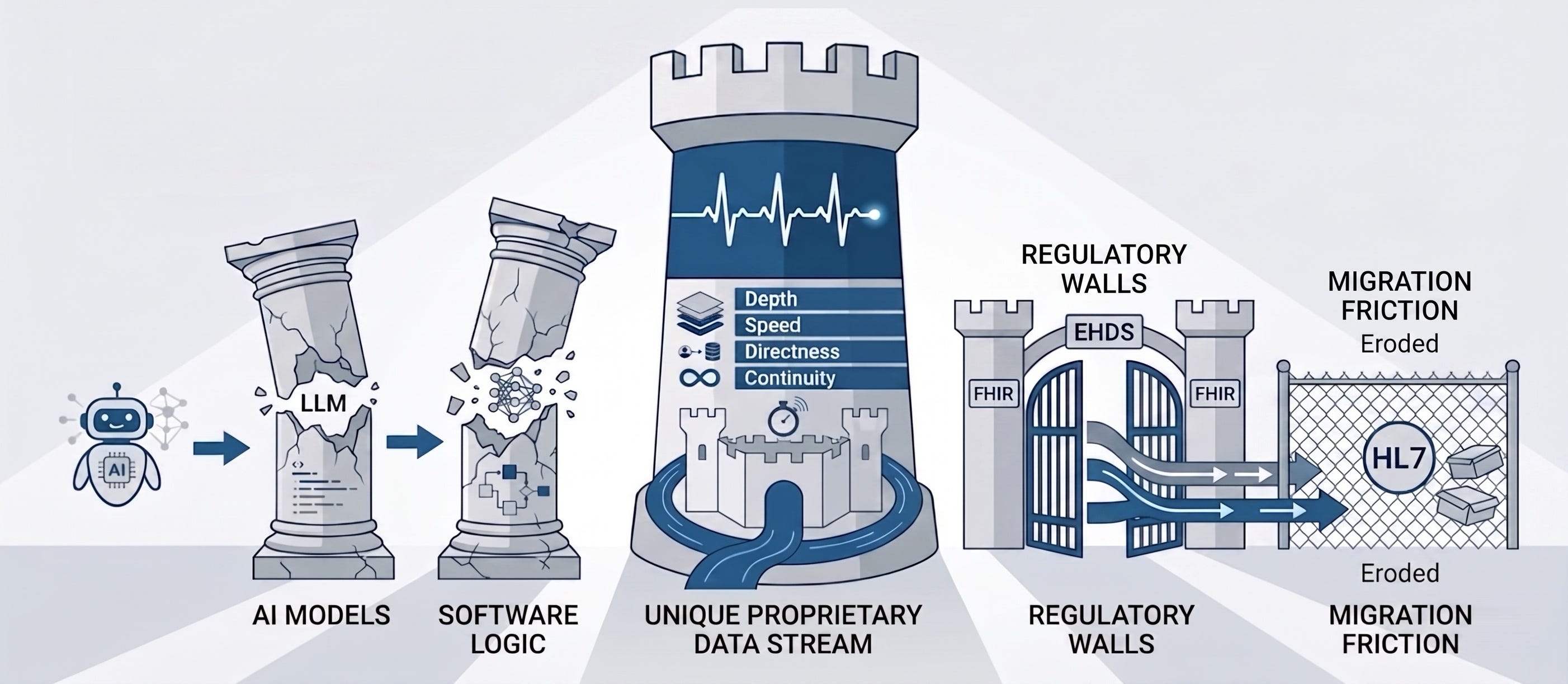
I held this belief from the beginning of our digital health work, and I made sure our strategy reflected it. What’s changed now is the environment around it. Every trend in AI, software economics, and data commoditization is converging on the same conclusion. If your competitive advantage doesn’t include proprietary access to a (continuously updated) data stream, you probably don’t have a competitive advantage at all - a hot take, I know, but hear me out.
The case that convinced me
When we were building software-as-a-medical-device for insulin-dependent patients, we were developing dosing decision support and hypoglycemia prediction algorithms, the kind of software companies like e.g. Hedia now are trying commercialize around as CE-marked products (yes, Hedia and others have yet to find a sustainable business model as I read it, but that’s a different point) . Around 150 to 200 million people worldwide use insulin.
The software was good. But the software was a vehicle. The algorithms are good, but relatively simple (excluding edge cases…). But the valuable part was the data stream(s). A granular, continuous record of insulin dose data. What each patient injected, when, in what context, and what happened to their glucose levels afterward.
I pushed us to build around that data stream because of how it was set up. If you wanted continuous, real-world insulin usage data, you had to be a major insulin manufacturer or manufacture the connected devices patients used. No one else had the patient relationship, the device infrastructure, or the regulatory status to produce it at scale, and it was unique, proprietary and prohibitively expensive others to generate.
Three properties made this data position difficult to attack.
First, the data had to be current (and accurate) to be safe. If you wanted to recommend the next best action for a patient, you needed to know their last injection (and their glucose levels). Not their injection from two weeks ago. Not from earlier today. Up to and including the last one. Without it, any recommendation carried unacceptable treatment risk. You might suggest a dose on top of insulin already active in the patient’s system. That could drive their blood sugar dangerously low. The longitudinal record was useful for spotting trends and flagging deteriorating adherence, but it couldn’t safely drive treatment decisions without the most recent data point. This meant the dataset was only useful if it was kept up to date continuously and reliably.
Second, the data was expensive to generate in general, but comparatively cheap for us. Getting a complete dosing record for a single patient required either a connected device that passively captured every dose (the insulin injection pen) or the patient actively logging every injection. For a standalone medtech company, building this from scratch would be enormously expensive. But we were already manufacturing and distributing the injection pens. Adding connectivity to a device that already existed in our supply chain was an incremental cost (though, ensuring accuracy was not small feat, massive credit to the device development team). We had the patient relationship, the distribution network, the regulatory infrastructure. The marginal cost of generating insulin dose data was a fraction of what it would cost anyone starting from zero - we were one of 3 companies that could do this in the world I would argue.
Third, patients would only generate this data in one place. A patient managing diabetes is not going to log insulin doses in two separate apps and they use just device to inject themselves (and generate the data) with a given drug. There is no benefit in doing that, only hassle. The value of the record depends on its completeness, and completeness means committing to one system. Splitting data across two platforms means neither can safely support treatment decisions. Every day a patient used a connected pen, the dataset got more complete, the product got more useful to them, and the cost for any competitor to offer something equivalent got higher. The competitor didn’t just need better software. They needed the patient to start their entire dosing history over from scratch, in a new system, for no immediate benefit.
The framework: data access is the moat, not ownership
The insulin case show how data advantage is not binary (you have it or you don’t) but along (at least) four dimensions. I now use this mental framework to judge a company’s long-term defensibility.
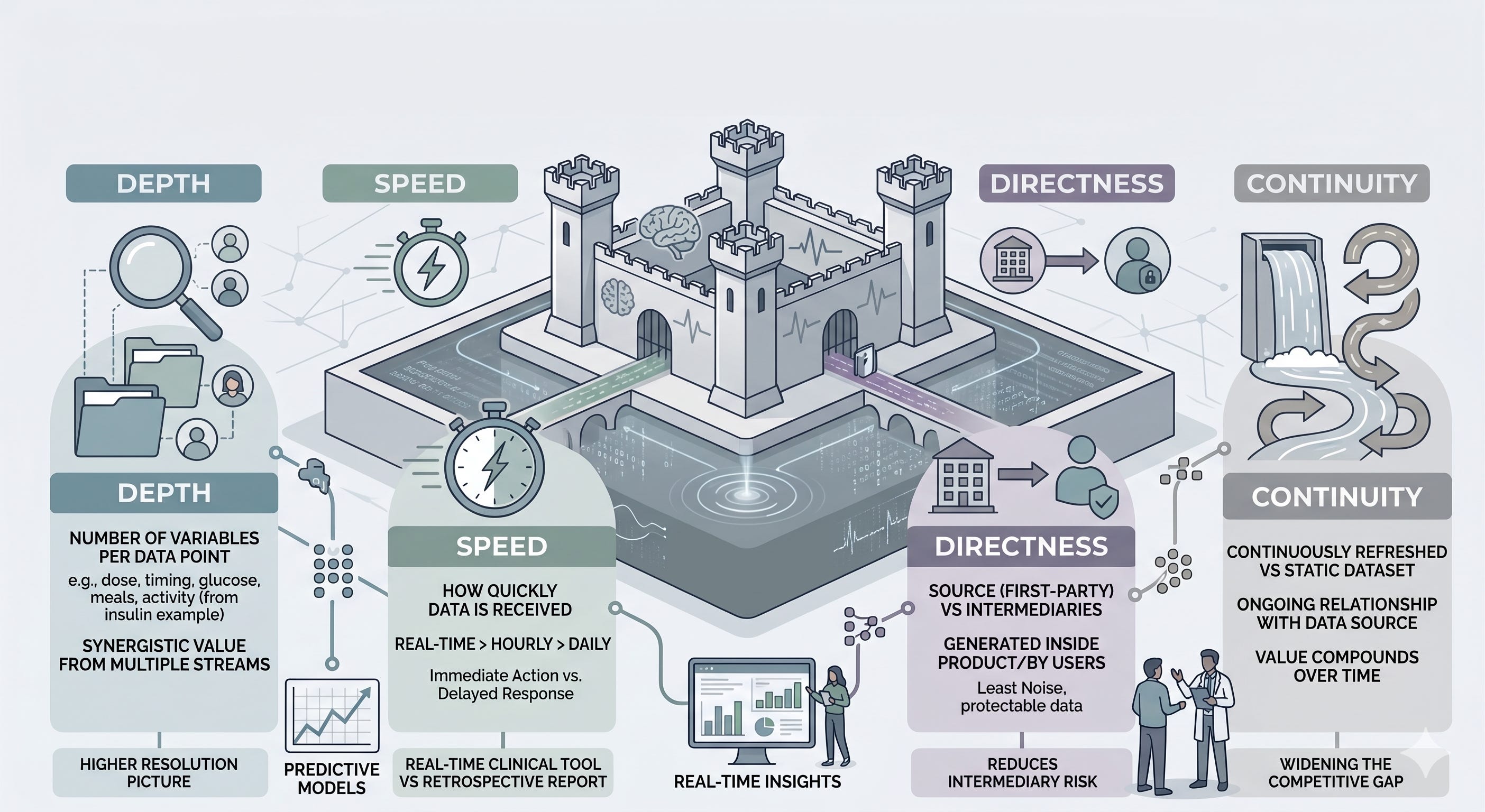
Depth. How many variables do you capture per data point? In the insulin case, it wasn’t just the dose. It was the timing, the glucose context before and after, the meal data, the activity data. Each additional variable makes the dataset more useful for modeling. A competitor who captures the same type of data but with fewer variables per record is working with a lower-resolution picture. In our case we had to partner our way to the glucose data of course, an equally important data stream, but one where those who have access to both gets syngergistic value add than just the one alone.
Speed. How quickly do you get the data? Real-time beats hourly. Hourly beats daily. In the insulin case, the difference between real-time dose data and yesterday’s dose data was the difference between a clinical tool and a retrospective report. If your competitor has the same data type but gets it with a 24-hour delay, your product can do things theirs can’t.
Directness. Do you get the data from the source, or through intermediaries? Every intermediary introduces noise, delay, and the risk that they will sell the same data to your competitors. First-party data, generated inside your own product by your own users, is the least noisy and easiest to protect.
Continuity. Is the data being generated right now? A dataset that stops being updated starts losing value immediately. A dataset that is continuously refreshed compounds in value over time. If you have an ongoing relationship with the data source and your competitor doesn’t, the gap between you widens every day.
Two companies might technically have access to the same type of data, but if one gets it deeper, faster, more directly, and continuously, and the other gets it in batches through a third-party aggregator, they are not in the same competitive position.
It explains why the payer in that market access meeting had the stronger hand. Their data was more current, covered more patients, and came directly from their own claims system. Our phase 3 data was deeper on certain clinical variables, but it was static, it stopped updating the day the trial ended. On three of the four dimensions, the payer had the advantage. If only we had had the real time data from people using out product at that point in time, we could change the dynamics by knowing more about the patients on our medicines than the payers.
Changes over the past five years
I’ve held this view since before AI became the main topic. What’s changed is that the market now provides strong(er) evidence for it. Three structural shifts are making data access the only lasting advantage left.
Software is losing its defensibility. The conventional wisdom in SaaS was that complex, well-engineered software was hard to replicate. That’s eroding. LLMs are turning individual developers into small teams. A single engineer using AI-assisted coding tools can produce what used to require a team of ten. The effect on cost is straightforward: software that required $2 million and 18 months to build can increasingly be produced for a fraction of that, in a fraction of the time. In healthcare, the collapse is slower because of regulatory requirements around validation and clinical evidence. But the direction is the same. If you’re a SaaS founder whose pitch starts with “our proprietary software,” ask yourself how long before someone can build something functionally equivalent for a tenth of the cost.
Most data is already commoditized. The vast majority of data that companies rely on is already accessible. Scraped, aggregated, licensed, published in open datasets. Weather data. Financial market data. Demographic data. Product reviews. Web traffic patterns. And in healthcare, regulation is actively pushing in the same direction: the EHDS will make electronic health records portable across EU borders by 2029, and interoperability standards like HL7 FHIR are turning what used to be siloed clinical data into structured, exchangeable formats. In our digital health work, we started implementing FHIR back in 2018 because we could see where this was heading. The pool of accessible data is growing in every sector, including the ones that used to be most protected.
What remains scarce is proprietary data that cannot be scraped, aggregated, or purchased. Data generated through a specific relationship between a company and its users. Data that requires infrastructure, trust, or sustained engagement to produce. Data that is only useful when it’s complete and current. The insulin dose data we built around was an extreme case. But the pattern shows up in many contexts.
Data migration is getting easier, and regulation is speeding it up. AI can now parse, clean, normalize, and transfer data between systems at a fraction of the effort it used to require. And regulation is pushing from the other side. The European Health Data Space (EHDS) regulation, adopted as Regulation (EU) 2025/327 and entered into force on 26 March 2025, establishes an EU-wide framework for health data exchange and reuse. By March 2029, cross-border access to patient summaries and e-prescriptions applies across all EU member states. By 2031, that extends to medical images, lab results, and discharge reports. Denmark is already making changes: MedCom governs FHIR standardization nationally, HL7 Denmark maintains “DK Core” profiles adapted to Danish requirements, and Danish health IT systems including Sundhedsplatformen (Epic) are expected to be fully integrated with updated profiles by 2028. Competitive barriers basedon “it’s too hard to move your data” are weakening.
In healthcare and life sciences, regulatory barriers still slow this considerably. SaMD classification, HIPAA, GDPR, the EU AI Act, MDR clinical evidence requirements. These moats are real and measured in years and millions of dollars. In industries without these regulatory barriers, software-based competitive advantages are collapsing rapidly, and the same pattern will reach healthcare, the moats are just slowing it down. The regulatory barriers will compress rather than disappear. When they do, the durable advantage will be (proprietary) data stream.
Where this leaves us
When I strip away everything that’s depreciating, software defensibility, model performance advantages, migration friction, even regulatory moats, what’s left is data access. The deeper, faster, more direct, and more continuous your access to a proprietary data stream, the harder your position is to replicate.
I see it being validated in company after company. The ones holding their valuation premiums in 2026 are the ones sitting on proprietary data assets: logistics companies with decades of shipment history, health platforms with years of patient data, financial data providers with real-time feeds that can’t be scraped from public sources. The ones getting hammered are the ones whose value was really just software, and whose software is now reproducible at a fraction of the original cost.
The sustainable version of this advantage isn’t about trapping users or hoarding data behind walls. Regulation in healthcare like EHDS is rightly pushing toward portability, and I support that. The advantage is about being so useful that users never have a reason to leave. If the product gives them genuine value from their data, day after day, the position maintains itself. Not because the data is locked away, but because the data is most useful in the context where it was created.
Five years from now, the most valuable companies in every vertical will be the ones with the best access to proprietary, continuously updated data streams that their competitors cannot replicate and deep integration between various data sets. These positions will have been built slowly, often without fanfare, through years of being the product that users trusted with their data. The companies that hold them may not look like AI companies at all. They’ll look like healthcare platforms, logistics networks, agricultural monitoring systems, financial data providers. They’ll all use AI. Everyone will. But the AI won’t be their advantage. The data, and the access to it, that makes their AI better than everyone else’s will be.
Software will be cheap. Models will be commodity. Data migration will be easy. Regulatory moats will narrow.
What about access to proprietary data that is costly to obtain, continuously generated, and expensive to replicate?
That will be the asset. The only asset. The one that survives.