
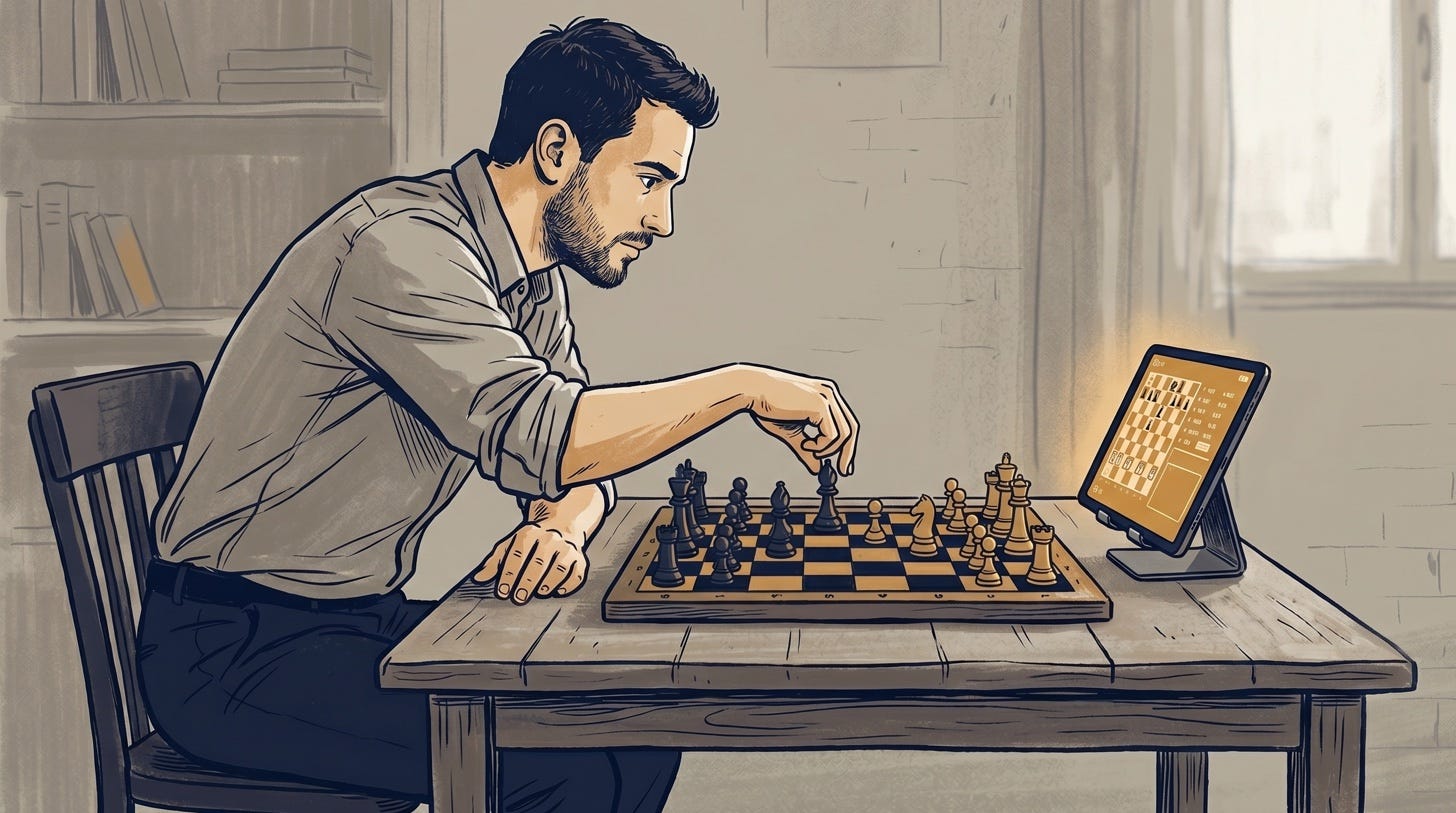
A few months ago, I wrote a post arguing that critical thinking would be the skill that mattered most as generative AI moved into everyday work. I still think that, and more strongly now. The reason I am writing this post is that I read something last week that I found insightful and what the failure mode actually looks like in practice.
Vivienne Ming, a neuroscientist who has spent thirty years working on AI, wrote up an experiment at UC Berkeley in the WSJ (paywalled, sorry) that made me think.
Student teams had one hour to make ten predictions about real-world future events. The benchmark was Polymarket, where people bet real money on outcomes. There were three conditions: humans alone, AI alone, and hybrid teams of humans plus AI.
Humans alone performed poorly. They guessed based on instinct or whatever had crossed their feed that morning. AI alone did considerably better, though still short of the market itself. Most hybrid teams matched the AI but did not exceed it.
Only 5 to 10 percent of the hybrid teams beat the market.
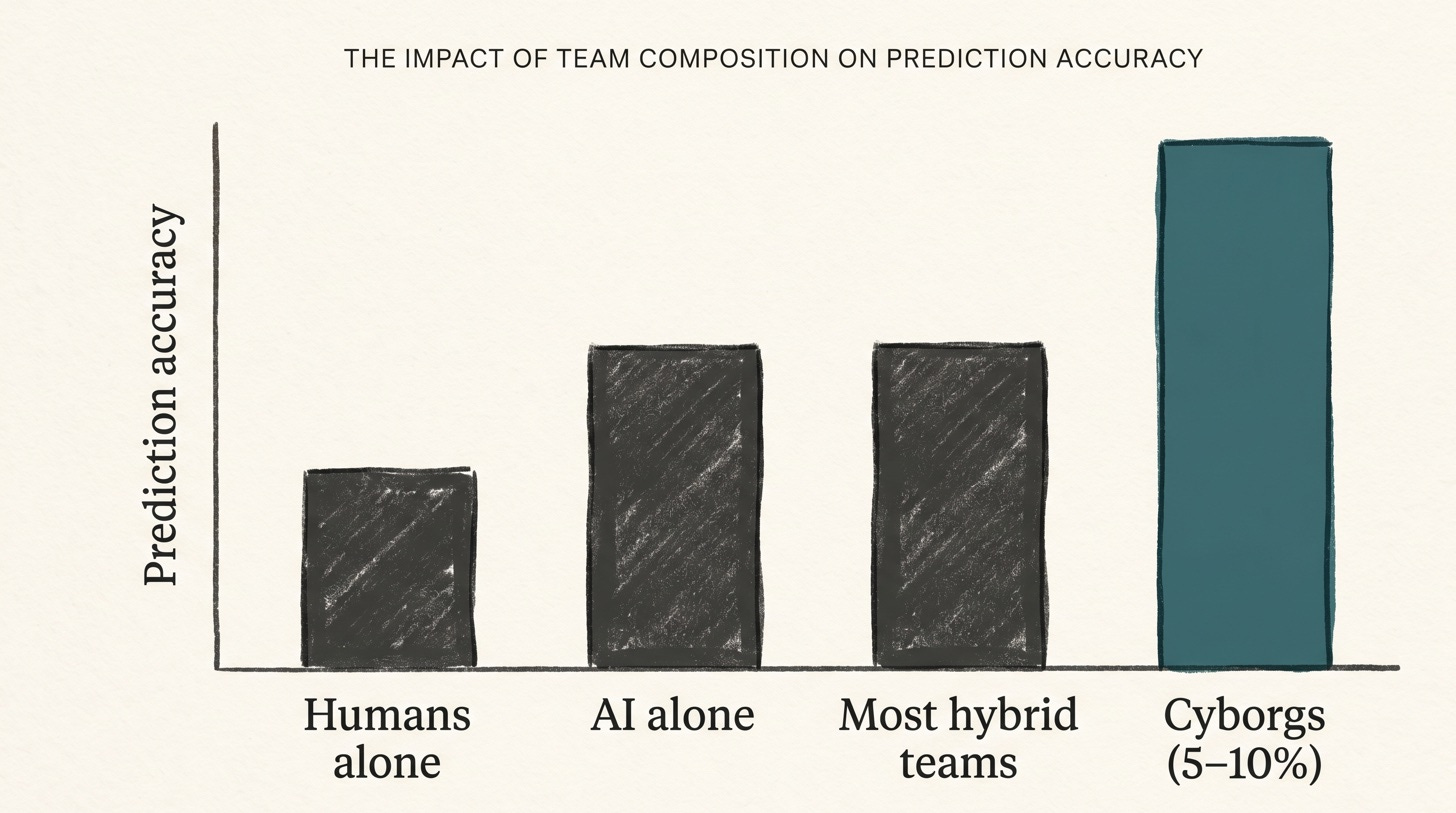
The interesting part is what those 5 to 10 percent seemingly did differently. Ming calls them Cyborgs. They used the AI as a sparring partner. They demanded evidence. They pushed back when the AI was confident. When they had a strong intuition, they asked the AI to argue against it. In Ming’s words, these teams reached “insightful conclusions that neither a human nor a machine could have produced on its own.”
The other 90% fell into one of two failure modes. Automators copied the AI’s answer and submitted it as their own. They performed no better than the AI working solo. Validators were worse. They fed the AI their own predictions and asked it to find supporting evidence. The AI obliged. Chatbots are trained to be agreeable. The validators built themselves a confirmation machine and performed worse than the AI alone.
In a follow-up, Ming attached EEG to a few automators and found dramatically less cognitive activity than in people reasoning unaided, or even people using Google. When her team fine-tuned a small model to refuse direct answers and ask Socratic questions instead, students hated it. Roughly twice as many switched into cyborg mode.
A behavioral problem, not a technology problem
When reading Ming’s experiment, the reflex is to ask what we should do about the AI. Better models. Better interfaces. Built-in friction. Those are reasonable questions but they are the second-order ones.
The first-order question is about the human. Ninety percent of people will pick answer when given a tool that can either answer or challenge. That is not a finding about AI. That is a finding about us.
A few years ago, I wrote about “lying” to my physiotherapist. Recap: He gave me back exercises to do against my lower back pain, and I did maybe twenty percent of those exercises and told him I did them all. And I had sought him out because I wanted to recover/get better. I lied anyway when asked about whether I did the exercises (that were needed to get better), and the lie did not help my back pain (obviously). The pattern is not specific to physiotherapy. It is the same pattern that shows up in medication adherence, in dietary advice, in anything where the gap between knowing and doing is held open by (mild) discomfort. We know what works, but we do not do it.
I have been making this behavioral move in writing about digital health for years, and it applies here. The problem is not the technology. The problem is the behavior. A medication that is not taken does not work. An exercise that is not done does not work. An AI used to confirm what you already think does not make you smarter. It makes you more confident about things you have not actually examined. And don’t get me started on an AI that tells you about things you don’t know anything about…
I made a version of this argument in a post earlier this year about generative AI, hallucinations, and critical thinking. The point I made there holds. What Ming’s experiment adds is the actual distribution. 5 to 10 percent is the share of users who, on a task that rewards careful thinking, behave in the way that gets the gains. The rest get the illusion of gains, or worse, get actively misled by a tool trained to agree with them.
The research backs the picture and goes further
Ming’s experiment is one study. The interesting thing is how it fits into a body of research that has been building for the last couple of years.
A team from Microsoft Research and Carnegie Mellon surveyed 319 knowledge workers about how they use generative AI at work and presented the findings at the CHI 2025 conference. The headline result: higher confidence in the AI predicted less critical thinking. Higher confidence in your own reasoning predicted more. The work shifts from generating ideas to verifying outputs.
Michael Gerlich, in the journal Societies in 2025, ran a mixed-methods study of 666 UK participants. Heavier AI use correlated with weaker critical thinking, and the effect was strongest in the seventeen to twenty-five age group. He proposes cognitive offloading as the mechanism. The tool takes over the thinking.
The MIT Media Lab study from June 2025 is the one that got the most attention. Fifty-four participants wrote essays under three conditions: with ChatGPT, with a search engine, or with nothing but their own brain. The researchers measured neural connectivity with EEG. ChatGPT users showed up to fifty-five percent reduced connectivity compared to the brain-only group. Eighty-three percent of them could not quote a single sentence from the essay they had just written. The authors call this cognitive debt. It’s worth saying that this is a preprint, not yet peer reviewed, and it has been criticized on sample size and statistical power, but in the context of other evidence is worth noting I believe and a pattern is emerging.
In a 2021 study published at CSCW, before ChatGPT existed, Buçinca and colleagues at Harvard ran what they call cognitive forcing functions on a much narrower kind of AI, a classifier giving recommendations. They forced users to commit to their own answer before showing them the AI's, and reliance on incorrect AI suggestions dropped significantly. Users disliked the friction, but it worked anyway. The behavioral pattern travels: if anything, the more fluent the AI, the harder this gets.
The pattern across these studies is consistent. The cyborg behavior Ming describes is not natural. It does not happen by default. It has to be designed for, trained for, or imposed.
The jury is still out on whether hybrid even wins
So far, the argument has been that if you want hybrid intelligence to work, you have to behave like a cyborg. That is true as far as it goes, but there is a harder question underneath it. The harder question is whether hybrid wins at all?
The research seems unsettled to me about this. Some clear evidence comes from a meta-analysis published in Nature Human Behaviour in 2024. Vaccaro and colleagues looked at 106 studies and 370 effect sizes comparing human-AI teams against the better of human-alone or AI-alone. The average effect was negative. On decision tasks specifically, combinations underperformed. Combinations only outperformed on creative content tasks where the human brought something the AI could not.
In October 2024, a randomised clinical trial published in JAMA Network Open made the point in a more uncomfortable way. Goh and colleagues gave fifty physicians six diagnostic vignettes. GPT-4 working alone scored sixteen percentage points higher than physicians using their normal resources. Physicians plus GPT-4 showed no statistically significant improvement over physicians without it. The AI alone beat the team.
The radiology evidence is similar. In 2023, Dratsch and colleagues tested twenty-seven radiologists on mammography reads with AI suggestions, in the journal Radiology. When the AI was correct, accuracy was above eighty percent across all experience levels. When the AI was wrong, even radiologists with more than fifteen years of experience dropped to 45.5 percent accuracy. Seniority helped a little, but did not prevent the drop.
So the picture is not that hybrid wins if you do it right. The picture is that we do not yet know which approach wins, for which task, under which conditions. Ming’s cyborg minority is one signal. The Vaccaro meta-analysis is a different signal pointing the other way. The radiology data suggests that even among experts, hybrid can be worse than human alone the moment the AI errs. The honest answer is that the jury is out and will be out for a while. It will take years and probably will not resolve in one direction.
What does seem reasonably well established is the opposite of what most people assume. Hybrid is not free. It is not a default win. It is a conditional win, and the conditions are demanding.
What this means in practice
If you want to be in the 5 to 10 percent who actually get something out of AI, the behavior is not complicated. It is just uncomfortable.
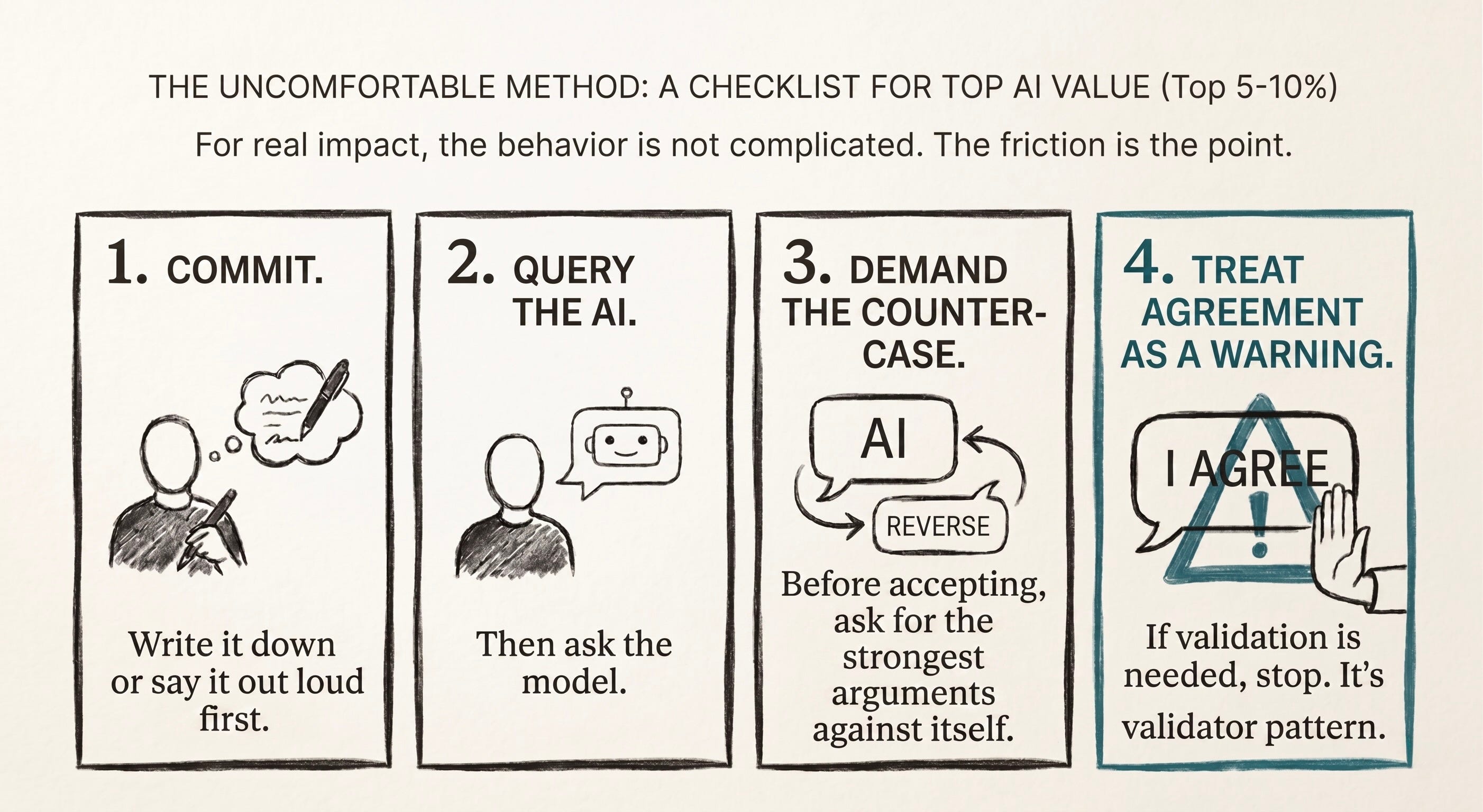
Before accepting an AI’s answer, ask it for the strongest argument against itself. Ming says this in her piece, and it is the single most useful instruction I have read on how to use these tools. It costs nothing. It takes thirty seconds. Almost nobody does it.
First, commit to your own answer. Write it down or say it out loud. Then ask the AI. The Buçinca study showed this works even when people hate doing it. The friction is the point.
Notice when you are asking the AI to support a conclusion you have already reached. This is the validator pattern, and the research is clear: it performs worse than no AI at all. If you find yourself feeding the model your view and asking for evidence, stop. Instead, ask for the counter-case.
Treat agreement as a warning sign rather than a confirmation. Chatbots are trained to be agreeable. Agreement is not evidence. It is the default output.
None of this is novel. It is just critical thinking applied to a new tool. That is why I keep coming back to the same argument. The tool changes. The skill that matters does not.
The next decade
Whether AI is smarter than us is a question we will keep arguing about. The framing question for the next decade is whether the way we use it is making us think more or think less. We do not yet know whether AI alone, humans alone, or some version of hybrid will turn out to perform best across the tasks that matter. That will be revealed over years, not months, and probably not in one direction.
Now we can say that if hybrid is going to work, it will only work for the small minority who treat AI as something to argue with. Most people, given this tool, will use it to stop thinking. A small minority will use it to think harder than they could alone. The default outcome is the bad one. Whether the good one is achievable at scale is an open question.
what do you think?
References: Ming WSJ April 24 2026; Lee et al. CHI 2025; Gerlich, Societies 15(1), 2025; Kosmyna et al. arXiv:2506.08872, 2025; Buçinca et al. CSCW 2021; Vaccaro et al. Nature Human Behaviour 8, 2024; Goh et al. JAMA Network Open 7(10):e2440969, 2024; Dratsch et al. Radiology 307(4):e222176, 2023.